
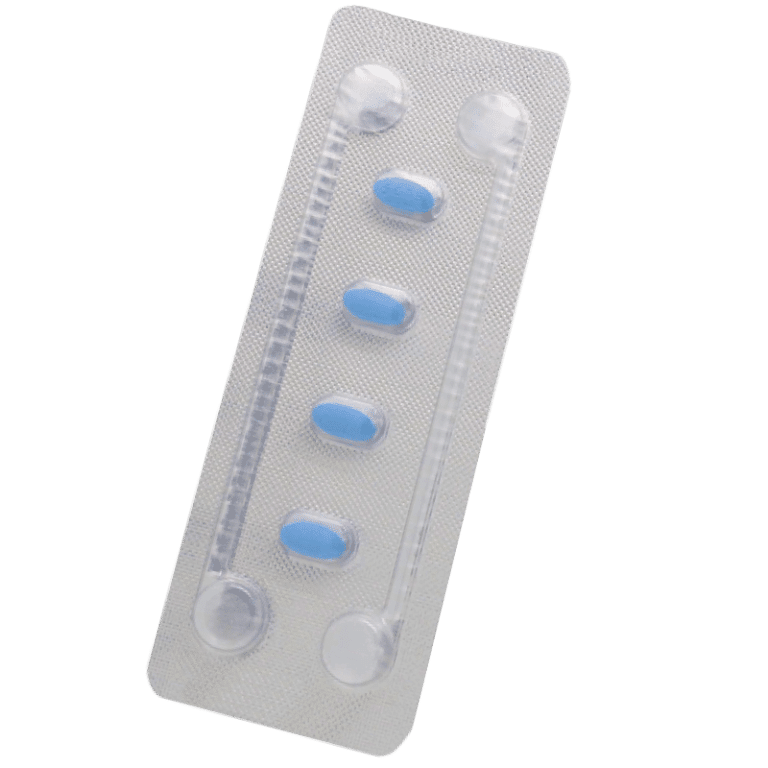


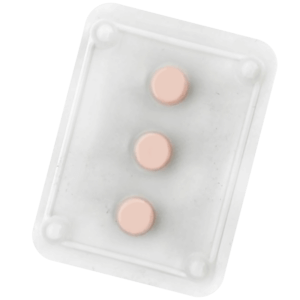
Relpax is a type of medication called a triptan, which is formulated specifically to help you with the symptoms of migraine attacks. It’s a tablet treatment that you take when you start to notice the symptoms of a migraine attack – it won’t prevent migraines from occurring if you take it on a scheduled basis.
Migraine symptoms are thought to happen as a result of temporary changes to your brain’s chemistry, instigated by a ‘trigger’. It can vary from person to person what triggers their migraine, for some it can be as a result of stress or lack of sleep, whereas some women get migraines as they’re coming on their period.
How does Relpax work?
When someone experiences a migraine, the blood vessels in their brain widen, allowing the transmission of more pain signals.
Relpax, like other triptans, works by binding to the serotonin receptors in your brain. This then causes the blood vessels in your brain to narrow, reducing the transmission of pain signals and improving your migraine symptoms.
What doses of Relpax are there?
There are two doses of Relpax: 20mg and 40mg. You’ll likely be prescribed the 40mg tablet unless you have a kidney impairment, in which case you’ll be recommended the 20mg dose.
It’s not recommended that you exceed 80mg (two tablets) a day. If you often feel like 40mg doesn’t help with your symptoms as you’d hoped, speak to our clinician. You might find another treatment to be more effective.
This page was written by The Treated Content Team.
This page was medically reviewed by Dr. Joseph Palumbo on November 28, 2024. Next review due on November 28, 2027.
How we source info.
When we present you with stats, data, opinion or a consensus, we’ll tell you where this came from. And we’ll only present data as clinically reliable if it’s come from a reputable source, such as a state or government-funded health body, a peer-reviewed medical journal, or a recognised analytics or data body. Read more in our editorial policy.
RelpaxEletriptan
How to take Relpax
You should always take Relpax exactly as instructed by our clinician. To take Relpax, simply swallow one tablet, whole, with water. Don’t take more than one tablet for the same migraine attack. If your migraine symptoms come back after you start feeling better, make sure you leave at least a two hour gap between doses.
How long does it take Relpax to work?
You should start to feel symptom relief within two hours of taking Relpax. If you don’t feel any symptom relief after two hours, don’t take another tablet to try and make it work better. Instead, get in touch with a clinician for guidance.
What should I do if I make a mistake when taking Relpax?
Don’t take more than two tablets of your prescribed dose per day. If you’ve accidentally taken too much Relpax, seek medical advice straight away.
As Relpax should only be taken when you get symptoms, you shouldn’t worry about forgetting to take a dose of Relpax.
This page was written by The Treated Content Team.
This page was medically reviewed by Dr. Joseph Palumbo on November 28, 2024. Next review due on November 28, 2027.
How we source info.
When we present you with stats, data, opinion or a consensus, we’ll tell you where this came from. And we’ll only present data as clinically reliable if it’s come from a reputable source, such as a state or government-funded health body, a peer-reviewed medical journal, or a recognised analytics or data body. Read more in our editorial policy.
RelpaxEletriptan
Relpax isn’t suitable for everyone, and there are some things that you need to be aware of when taking it.
Here’s all the official infoon it. If anything is unclear, let our clinician know, and they can talk with you about it.
RelpaxEletriptan
Relpax: FAQ
Have something specific you want to know? Search our info below, or ask our experts a question if you can’t find what you’re looking for.
How is Relpax different from other treatments for migraine?
Answer:
Relpax is a tablet treatment, belonging to the ‘triptan’ class of medicines, which all work in similar ways to treat your symptoms. Many migraine treatments come in the form of triptan tablets, though you might find that different triptans suit you more or less, and it might take a bit of trial and error to find the best one for you.
If you don’t want to take a tablet or a triptan, you can also get painkillers or antiemetic (anti-sickness) treatments, which can also come as a powder that you can dissolve in liquid, or nasal sprays. If you’re not sure which migraine treatment could be best for you, talk to us about your health, and we should be able to point you in the right direction.
Which dose of Relpax should I take?
Answer:
If you have a kidney impairment then you should take the 20mg dose of Relpax, otherwise you’ll likely be prescribed the 40mg dose. If one 40mg tablet isn’t working to help your symptoms, then your clinician might recommend taking two tablets at the onset of your symptoms - but you shouldn’t increase your dose without first speaking with a clinician.
How effective is Relpax?
Answer:
Relpax is a proven migraine treatment. In clinical trials it has shown itself to be more effective than both sumatriptan (one of the most popular ‘triptan’ medications) and placebo after two hours.[1][2]
Do I need a prescription for Relpax?
Answer:
Yes, you need a prescription for Relpax. This is so that a clinician can make sure it’s safe and suitable for you before you can get it. Triptans also aren’t suitable for headaches that aren’t caused by migraine, so they might also want to check that your symptoms are caused by a migraine, and not something else.
Treated trusted source:
Mathew, N.T., et al. (2003). Comparative Efficacy of Eletriptan 40 mg Versus Sumatriptan 100 mg. Headache: The Journal of Head and Face Pain, 43(3), pp.214–222.
Goadsby, P.J., et al. (2000). Eletriptan in acute migraine: A double-blind, placebo-controlled comparison to sumatriptan. Neurology, 54(1), pp.156–156.
Last updated on Nov 27, 2024.
How we reviewed this page:
Our experts continually monitor new findings in health and medicine, and we update our articles when new info becomes available.
Nov 27, 2024
Published by: The Treated Content Team.Medically reviewed by: Dr. Joseph Palumbo, Senior Medical Adviser
How we source info.
When we present you with stats, data, opinion or a consensus, we’ll tell you where this came from. And we’ll only present data as clinically reliable if it’s come from a reputable source, such as a state or government-funded health body, a peer-reviewed medical journal, or a recognised analytics or data body. Read more in our editorial policy.
This is healthcare on your terms.
All from the comfort of your device. Get access to what you need, when you need it.
100% online
Ask questions and get expert recommendations, at the touch of a button.
Tailored choices
We'll narrow down some treatments for you to choose from based on your medical profile.
Secure shipping
Receive your treatment by express delivery, in discreet packaging.
Easy automatic refills
Set your own delivery schedule and pause or make changes any time you like.
We're making healthcare more about you. Sign up to our newsletter for personalised health articles that make a difference.
Disclaimer: The information provided on this page is not a substitute for professional medical advice, diagnosis, or treatment. If you have any questions or concerns about your health, please talk to a doctor.
Dr. Joseph Palumbo
Senior Medical Adviser
Joseph joined Treated in 2023, and is one of the lead doctors providing prescribing services for the platform.
When we present you with stats, data, opinion or a consensus, we’ll tell you where this came from. And we’ll only present data as clinically reliable if it’s come from a reputable source, such as a state or government-funded health body, a peer-reviewed medical journal, or a recognised analytics or data body. Read more in our editorial policy.
Reviews you can trust
All of our reviews are collected from real patients after their treatment has been delivered.
We publish reviews collected through independent platforms including Reviews.io and Trustpilot.