The link between weight and mental health is far from straightforward. Weight struggles can worsen existing mental health issues and, in some cases, even contribute to new ones.
One study found that about 40% (2 in 5) people with overweight or obesity are diagnosed with a psychiatric disorder, most commonly anxiety, psychosis, depression, or an eating disorder.

So, at least in theory, weight loss injections (WLIs) can help lift your mood by addressing one of the main sources of emotional distress: the extra weight (and by “weight”, we don’t mean just the physical aspect, but also the stigma and social pressures that sometimes come with obesity).
Let’s take a look at what the research has to say about how WLIs can affect mental health.
WLIs have several proven health benefits beyond just weight loss, such as lowering cardiovascular risk and improving blood sugar levels.
Many users also report better mental health, with improved mood, reduced cravings, better quality of life, and improvements in anxiety and depression. As an example, our user survey found that 90% (9 in 10) of users experienced increased confidence within three months of starting WLIs.
That said, large safety reviews note that psychiatric effects can vary and are still being actively studied.
Here’s how WLIs can support mental health in more detail:
Many people prefer their appearance after losing weight, which often improves body satisfaction, mood, and overall quality of life.
Interestingly, these psychosocial gains don’t always correlate with the amount of weight loss, which could suggest—purely speculatively—that even the process of trying to lose weight may offer meaningful mental health benefits.
People with obesity often experience what’s been called “food noise”, which basically refers to constant thoughts about what, when, or how much to eat, often accompanied by guilt.
Recent research suggests that GLP‑1 receptor agonists (the drugs used in WLIs) can reduce this mental clutter by lowering appetite signals, cravings, and preoccupation with food.
Anecdotally, users report that fewer intrusive food thoughts can free cognitive and emotional bandwidth for work, relationships, hobbies, or other areas that were previously overshadowed by constant food-related worry.
But more research is needed to fully measure this “freeing up” effect.
Still-ongoing research suggests that WLIs can help with other addictive behaviors and substance misuse, including alcohol and smoking.
A recent randomized clinical trial found that once-weekly semaglutide (the active drug in Ozempic and Wegovy) reduced both cravings for and consumption of alcohol over nine weeks of treatment. The same study also linked semaglutide to a reduction in smoking.
If WLIs decrease substance use (like alcohol and smoking), this could in turn reduce mood disorders, anxiety, and the social or work-related harms often associated with addiction — another way in which these medications can support mental health.
An ongoing trial is currently investigating semaglutide’s potential to reduce alcohol consumption.
GLP-1s have reduced binge eating and emotional eating behaviors in several clinical and observational studies. Participants in these studies often report:
These behavioral shifts are partly due to appetite suppression and changes in the brain’s reward system.
Being more intentional with eating might have a knock-on effect on your overall health, including mental health. Improved eating habits support better nutrient intake, stronger satiety signals, and more balanced blood sugar levels, which are all linked to better mood and energy.
There’s also growing interest in GLP-1’s effects on the gut-brain axis. Though more research is needed, GLP-1s might help regulate mood by promoting the growth of “good” gut bacteria, improving gut health, and correcting nutrient deficiencies.
When neuroinflammation (inflammation in the brain) affects your system, it can disrupt levels of important brain chemicals like norepinephrine, serotonin, and dopamine, which can trigger anxiety and depression.
Studies in animals show that GLP-1s can help tone down neuroinflammation, which means they could have protective effects on thinking and mood.
But human data linking reduced neuroinflammation to improved mood are still sparse, so more research is needed before we can pin this down as a clear route to better mental health.
Being overweight can make movement uncomfortable and leave some people feeling self-conscious, especially in the gym or group classes.
But losing weight can:
Plus, exercise releases endorphins that reduce stress and can help lift your mood.
It’s possible for a small number of people, though it’s difficult to gauge the exact impact of WLIs on mental health because:
(a) obesity itself is linked to a higher risk of mood disorders,
(b) clinical trials usually exclude people with severe psychiatric conditions (this caution probably harks back to rimonabant, a once-promising weight-loss drug pulled in 2008 over serious psychiatric side effects), and:
(c) media hype can increase the likelihood of people reporting certain side effects.
But here’s what we know so far:
Early side effects like nausea, vomiting, dizziness, and fatigue are common when starting GLP-1s, especially while increasing the dose (titration). These can negatively affect your mood and make day-to-day life more difficult, especially if they’re persistent or severe.
There have also been reports of mood changes, depression, and suicidal thoughts, which is why regulators like the FDA keep a close eye on WLIs.
One study found that GLP-1 treatment was associated with a higher risk for psychiatric disorders:
That said, large trials tell a much more reassuring story. Pooled data from over 3,000 people using semaglutide found no clear increase in depression or suicidal behavior in those without major mental health conditions. In fact, semaglutide was linked to a small drop in depressive symptoms (though not considered clinically meaningful).
However, your risk of experiencing psychiatric side effects might be increased by factors like:
Here’s what research tell us about anxiety, depression, and suicidal thoughts with GLP-1s:
| Category | Findings |
|---|---|
| Gender | Women are at higher risk than men: about 2 times as likely for anxiety and 2.5 times as likely for suicidal thoughts. |
| Age | Younger adults (18–49) were about 3 times more likely than the reference group to experience suicidal thoughts or attempts. |
| Race | Black patients have a higher risk of suicidal thoughts or attempts compared to White and Asian patients. |
| Dose effects | Higher doses of liraglutide (2.4–3.0 mg) are linked to slightly more psychiatric events, especially insomnia, low mood, and nervousness. |
| STEP clinical studies | Incidence of psychiatric events were generally uncommon, though rates varied between drugs and doses: Liraglutide 3 mg: 15%, Semaglutide 2.4 mg: 3%-6%, Placebo: 1%-10.6% |
| Case reports | Two people developed depression shortly after starting semaglutide, but improved quickly after stopping. |
| Real-world studies | FDA data at first flagged reports of depression and suicidal thoughts, but once other factors were taken into account, no direct link was found. Real-world studies suggest that semaglutide doesn’t raise suicidal thoughts and might even help ease anxiety in people with diabetes. |
Long story short: Evidence is mixed. Most large studies don’t show a direct link between GLP-1s and serious psychiatric events, but some case reports suggest caution, especially if you already have risk factors like a family history or existing mental health issues.
Whether influenced by social media, external pressure, or personal beliefs, it’s sometimes easy for some people to tie their self-worth to their appearance.
Rapid weight changes can stir up or worsen body-image worries, leading some to obsess over how they look, chase further changes, or feel constant pressure to keep the weight off, which can fuel anxiety, unhealthy habits, and self-criticism.
While this is most common after major weight loss like bariatric surgery, it’s possible that pharmacological weight loss could set off similar concerns. This is why screening for body-image issues before starting treatment can help clinicians identify who might benefit from psychological support along the way.
Some people on WLIs notice a dulling of pleasure from food and, occasionally, other activities (a disorder called anhedonia). This happens because GLP-1s affect the brain’s dopamine “reward” system: they can rev up dopamine in some areas while dialing it down in others, which can reduce the “feel-good” signals from things that used to be pleasurable.
While changes in appetite and food reward are a welcome side effect for most people, for a minority, this can spill over into other aspects of life, leaving them feeling flat or less motivated.
However, evidence is mostly anecdotal or from small studies, so it’s something to be aware of, not a guaranteed effect.
Some people on GLP-1s have reported sexual side effects like lower libido, difficulties reaching orgasm, or erectile dysfunction. Controlled trials, however, haven’t flagged major sexual problems, so the evidence is mixed and still evolving.
Weight loss has also been linked to relationship problems. One study suggests that adults who underwent bariatric surgery were more than twice as likely to get divorced within five years compared to the general U.S. population.
For GLP-1 users, large studies are lacking, but clinical experience and media stories suggest relationship changes can happen and should be talked through during counselling.
It’s common to expect that losing weight will “fix” some if not all emotional problems. And for many people, it does improve self-esteem and mood. But for others, it can expose deeper issues, like chronic depression, past trauma, or relationship problems, that go beyond what weight loss alone can fix.
Also, sometimes GLP-1 medication just doesn’t work as well as you’d hoped, or even when the treatment is successful, the emotional payoff doesn’t quite live up to your expectations. And when this happens, it can affect your mood or leave you feeling disappointed.
That’s why it can help to set realistic goals before starting treatment, recognise that weight loss isn’t a cure-all, and be open to psychological support as part of your treatment when needed.
Many clinical studies specifically exclude patients with unstable or severe psychiatric illness, so evidence in those groups is limited and clinicians typically need to make decisions on a case-by-case basis.
That said, in most cases, people with stable mental health conditions can use WLIs, though there are a few strings attached.
Your doctor will typically screen for any personal or family history of mental health issues like depression, suicidal thoughts, or eating disorders, and keep a close eye on how you’re doing throughout treatment. They’ll also likely keep your mental health provider in the loop during your treatment.
For the most part, yes. There haven’t been any consistent interactions reported between GLP-1s and common antidepressants (like SSRIs or SNRIs), and many clinicians prescribe them together.
However, taking antidepressants at the same time as WLIs might slightly slow down your weight loss progress. And some side effects, like nausea, mood changes, or lower blood sugar are more likely to happen if you take these two types of medications together.
If you have a history of suicidal thoughts or depression, your clinician will likely involve your psychiatrist and schedule regular check-ins to make sure you’re safe.
All in all, co-prescribing is fairly common and usually safe, as long as there’s regular and open communication between you, your prescriber, and your mental health team.
In many cases, yes. In fact, GLP-1s are sometimes prescribed to help offset the weight gain caused by antipsychotics.
There aren’t many known drug interactions between GLP-1s and antipsychotics, but a few case reports have described unexpected psychiatric changes after starting GLP-1 treatment in people with psychosis (like worsening delusions in one instance). Because of this, clinicians usually team up with mental health professionals and keep a close eye on symptoms when treating patients with a history of psychosis.
If you start noticing changes in mood while taking WLI’s, it’s critical that you contact your healthcare provider as soon as possible.
It’s also important to note that mood changes often don’t happen in a vacuum. Factors like personal history, recent stressful life events, and other medications can all play a role.
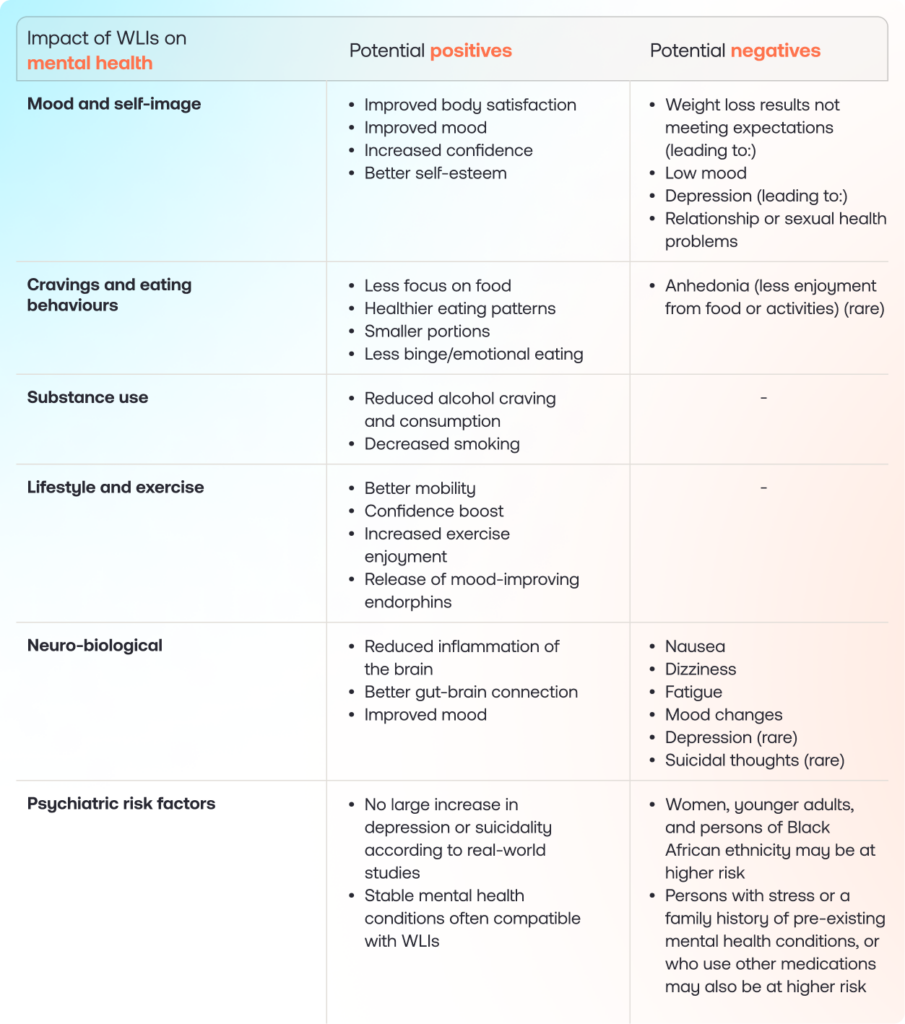
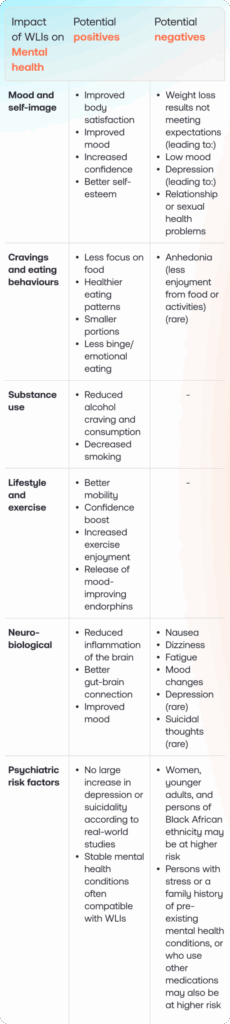
Below is a summary of the main ways WLIs can impact mental health:
Obesity as pleiotropic risk state for metabolic and mental health throughout life. Translational Psychiatry, 13(1), pp.1–12.
GLP-1 RAs and Cardiovascular and Kidney Outcomes by Body Mass Index in Type 2 Diabetes. JAMA Network Open, 8(9), pp.e2530952–e2530952.
Efficacy of GLP-1 Receptor Agonist-Based Therapies on Cardiovascular Events and Cardiometabolic Parameters in Obese Individuals Without Diabetes: A Meta-Analysis of Randomized Controlled Trials. Journal of diabetes, 17(4), p.e70082.
GLP-1 Receptor Agonists and Related Mental Health Issues; Insights from a Range of Social Media Platforms Using a Mixed-Methods Approach. Brain Sciences, 13(11), pp.1503–1503.
Psychiatric Safety of Semaglutide for Weight Management in People Without Known Major Psychopathology. JAMA Internal Medicine, 184(11), pp.1290-1300.
Psychological benefits of weight loss following behavioural and/or dietary weight loss interventions. A systematic research review. Appetite, 72(72), pp.123–137.
What Is Food Noise? A Conceptual Model of Food Cue Reactivity. Nutrients, 15(22), pp.4809–4809.
Once-Weekly Semaglutide in Adults With Alcohol Use Disorder. JAMA Psychiatry, 82(4), pp.395-405.
Semaglutide Therapy for Alcohol Reduction (STAR). ClinicalTrials.gov (NCT06015893).
Effect of Weekly Subcutaneous Semaglutide Vs Daily Liraglutide on Body Weight in Adults with Overweight or Obesity without Diabetes. JAMA, 327(2), p.138.
Nutritional priorities to support GLP-1 therapy for obesity: a joint Advisory from the American College of Lifestyle Medicine, the American Society for Nutrition, the Obesity Medicine Association, and The Obesity Society. The American Journal of Clinical Nutrition, 122(1), pp.344-367.
Obesity and malnutrition in children and adults: A clinical review. Obesity pillars, 8, pp.100087–100087.
Effect of Antidepressants on Glucagon-Like Peptide-1 Receptor Agonist-Related Weight Loss. The Journal of Pharmacy Technology: JPT: Official Publication of the Association of Pharmacy Technicians, 38(5), pp.283-288.
Anti-Inflammatory Effects of GLP-1 Receptor Activation in the Brain in Neurodegenerative Diseases. International Journal of Molecular Sciences, 23(17), p.9583.
The European Medicines Agency recommends suspension of the marketing authorisation Acomplia.
Association of Semaglutide with Risk of Suicidal Ideation in a real-world Cohort. Nature Medicine, 30, pp.1–9.
The risk of depression, anxiety, and suicidal behavior in patients with obesity on glucagon like peptide-1 receptor agonist therapy. Scientific Reports, 14(1), 24433.
Bariatric Surgery Linked to Doubling Chance of Marriage or Divorce.
Changes in food preferences and ingestive behaviors after glucagon-like peptide-1 analog treatment: techniques and opportunities. International Journal of Obesity, 49, pp.418–426.
The Impact of Glucagon-like Peptide-1 Receptor Agonists on Erectile Function: Friend or Foe? Biomolecules, 15(9), p.1284.
Glucagon‐like peptide agonists for weight management in antipsychotic‐induced weight gain: A systematic review and meta‐analysis. Acta Psychiatrica Scandinavica, 150(6), pp.516-529.
Sourcing guidelines:
When we present you with stats, data, opinion or a consensus, we’ll tell you where this came from. And we’ll only present data as clinically reliable if it’s come from a reputable source, such as a state or government-funded health body, a peer-reviewed medical journal, or a recognised analytics or data body. Read more in our editorial policy.
Have a subject you’d like us to cover in a future article? Let us know.
We're making healthcare more about you. Sign up to our newsletter for personalized health articles that make a difference.
Disclaimer: The information provided on this page is not a substitute for professional medical advice, diagnosis, or treatment. If you have any questions or concerns about your health, please talk to a doctor.
Authorised and Regulated by:
We couldn't find what you're looking for.
Here's everything we treat. Or, if you're looking for something we don't have yet, you can suggest something.
(And leave your email too, so we can let you know if we write an article based on your suggestion.)
By clicking 'Subscribe now' you're agreeing to our Privacy Policy.
(And leave your email too, so we can let you know if we write an article based on your suggestion.)
Last updated on May 14, 2026.
Our experts continually monitor new findings in health and medicine, and we update our articles when new info becomes available.
May 14, 2026
Published by: The Treated Content Team. Medically reviewed by: Mr Craig Marsh, Clinical ReviewerHow we source info.
When we present you with stats, data, opinion or a consensus, we’ll tell you where this came from. And we’ll only present data as clinically reliable if it’s come from a reputable source, such as a state or government-funded health body, a peer-reviewed medical journal, or a recognised analytics or data body. Read more in our editorial policy.
Clinical Reviewer
Pharmacy prescriber Craig is based in the UK and regularly reviews our content to ensure clinical accuracy. On pages he's checked, you'll see his reviewer card.
MeetHow we source info.
When we present you with stats, data, opinion or a consensus, we’ll tell you where this came from. And we’ll only present data as clinically reliable if it’s come from a reputable source, such as a state or government-funded health body, a peer-reviewed medical journal, or a recognised analytics or data body. Read more in our editorial policy.