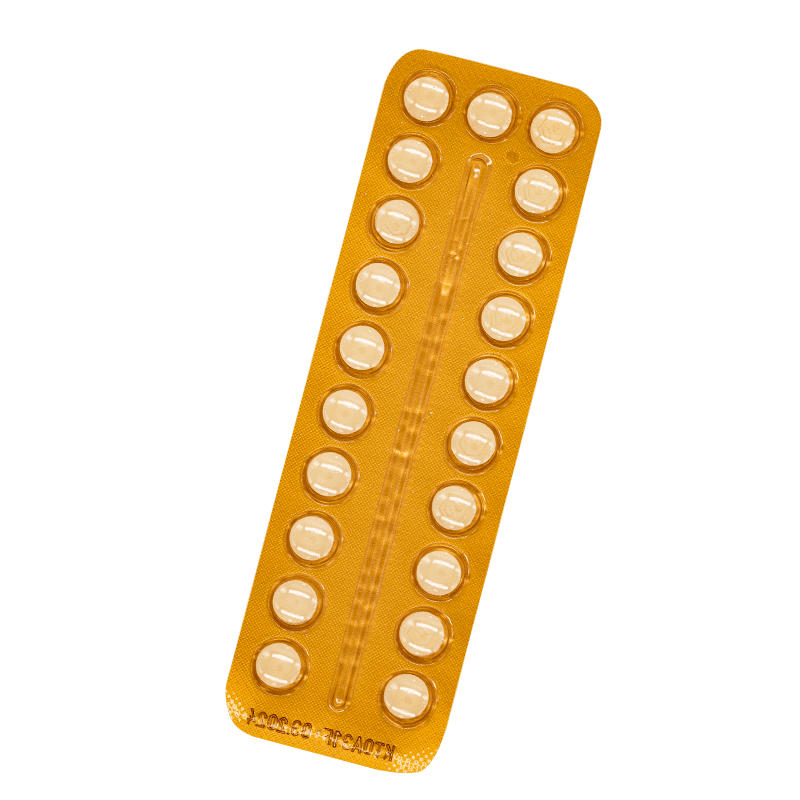
Weight loss pills are treatments that can help you lose weight by reducing your appetite, increasing feelings of fullness, or changing how your body absorbs fat. You can use them if your BMI is 30 or above, or if it’s 27 or above and you have a weight-related health condition, like type 2 diabetes. They’re mostly prescription-only, but one option (Alli) is an over-the-counter (OTC) medicine available without a prescription.
Here, we’ll take a closer look at all the weight loss pills available and how they work.

Weight loss pills work differently depending on which one you use. Ultimately though, they contribute toward helping you consume fewer calories each day.
Creating a calorie deficit is a proven way of losing weight, and is the principle behind most weight loss plans. Exercising more and eating a balanced, nutrient-rich diet is also essential to losing weight safely while maintaining healthy energy levels. But in simple terms, burning more calories than you consume is generally how weight loss is achieved.
So how do weight loss pills help this happen? There are a range of weight loss pills available, and each of them targets different processes in your body. Some of them decrease your appetite, and some slow down gastric emptying as well. Other types of pills limit how much fat your gut absorbs.
Currently, there are six weight pills to choose from: Wegovy, Contrave (known internationally as Mysimba), Foundayo, orlistat, Xenical, and Alli.
Xenical is the brand-name version of orlistat, and Alli contains the same active ingredient (orlistat) as these two medications, but in lower doses. These three treatments all work by blocking fat absorption.
Wegovy contains semaglutide, which works by suppressing your appetite, reducing hunger cues, and helping you feel fuller after eating smaller portions of food. It’s a type of GLP-1, which is the same class of medications that Foundayo and the injection Zepbound belong to. Contrave works differently, and targets brain receptors involved in appetite and mood.
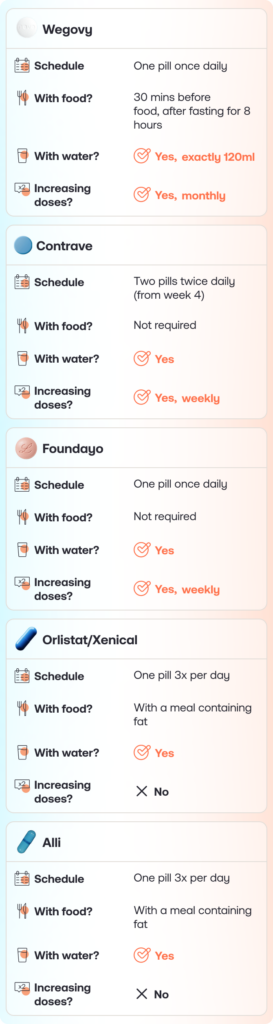
The Wegovy pill, sometimes called Oral Wegovy, is the tablet version of injectable Wegovy. Whereas the injections are self-administered once a week, the Wegovy pill is taken daily.
It works in the same way as the injections do — the pills contain semaglutide, which works by dampening hunger cues and increasing satiation (fullness) after you’ve eaten. It also slows down gastric emptying, which means your body takes longer to digest food, which can reduce hunger after meals.
In trials, a daily 25 mg dose of oral semaglutide was shown to be effective for weight loss.
Contrave is a weight loss medication that contains bupropion and naltrexone, which work together to target brain receptors involved in appetite, food cravings, and pleasure from eating.
You can use Contrave if your BMI is over 30 or if it’s 27 or above and you have a weight-related health condition, such as heart disease.
Contrave might be a good choice if you struggle with food noise or emotional eating, as bupropion is used in antidepressants and smoking cessation treatments. It’s a titration treatment, which means you take one pill a day for the first week, and increase this each week (so two pills during the second week and so on) until you reach week four, from which point you’ll take the maintenance dose of four pills a day.
Orlistat and Xenical are effectively the same medication. Orlistat is the generic, and Xenical is the brand-name version. Orlistat is also the active ingredient in Alli.
Orlistat works by stopping fat from being absorbed during digestion. By reducing the amount of fat you’re digesting, orlistat can effectively remove the calories found in fat from your diet. You then pass this fat out in your stool. It’s been shown to be an effective weight loss treatment when used daily over a two-year period. It’s thought to reduce fat uptake by up to one-third.
Xenical and Orlistat are available in similar doses, so it’s usually a matter of deciding which one you’re more comfortable using. Generic medications are usually cheaper than brand-name versions.
Alli is a low-dose version of Xenical that doesn’t require a prescription. Like other weight loss treatments, it’s designed to be used alongside a balanced, reduced-calorie diet and increased activity.
It contains orlistat, and like Xenical, works by blocking fat absorption from the meals you eat. Because it’s a lower dose, it’s thought to reduce fat uptake by less than Xenical (up to one-fourth). Alli is taken three times a day within an hour of eating, and is a fixed-dose pill that requires no titration. You can’t take Alli for any longer than six months at a time without a doctor’s prescription.
Foundayo, like the Wegovy pill, is a GLP-1. It contains orforglipron, which mimics your body’s GLP-1 hormone to slow digestion while regulating your blood sugar and appetite.
It works in the same way as GLP-1 injections do, and is available in six doses. You’ll usually start on the lowest dose pill, taken once a day, and move up (titrate) to the next dose after 30 days. The maximum daily dose of Foundayo is one 17.2 mg pill a day.
You might find that while using Foundayo, you’re happy with a lower maintenance dose, such as the 9 mg or 14.5 mg pill, which you can stay on for the rest of the course if you feel like it’s working well enough to help you maintain steady weight loss.
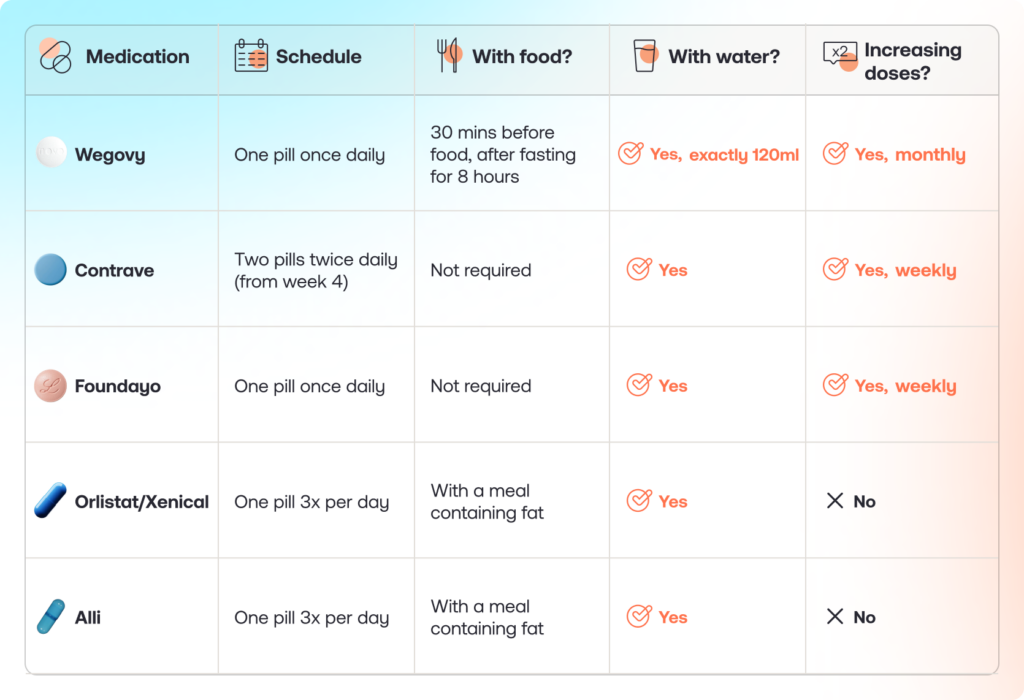
All weight loss pills need to be taken with water, but Wegovy needs to be taken with exactly 120 mL (about 4 fluid ounces), so that the coating of the tablet doesn’t break down too quickly in the body. And although all weight loss pills are taken daily, some treatments involve taking more than one each day. Orlistat, Xenical and Alli all come as a fixed dose, whereas Wegovy, Contrave and Foundayo all need to be titrated, which means the doses are gradually increased until you reach a maintenance dose.
Weight loss pills are safe to use for most people. If you take them as you’ve been instructed to by your clinician, alongside a healthy diet and regular physical activity, they can be an effective part of your weight loss plan.
It’s also important that you only get weight loss pills from trusted sources, where licensed professionals have prescribed them to you. Because they require a prescription, you should never use weight loss prescription pills bought without one, as unregulated medications may often be ineffective or unsafe to use.
You might experience some side effects while taking weight loss pills. These can vary depending on which treatment you’re using.
GLP-1s such as Wegovy and Foundayo and can sometimes cause gastrointestinal side effects, like nausea, vomiting and diarrhea. Fat-absorption blocking pills like Orlistat and Alli can cause side effects like urgent bowel movements, or oily, fatty stools.
If any side effects caused by your weight loss pills are getting in the way of your treatment, talk to your clinician about them. They might look at your dosing schedule, or recommend you try a different treatment.
When starting a weight loss pill, it might seem like an obvious choice to pick the most effective treatment that can help you lose weight the quickest and push you toward your target weight.
But it’s important to understand the different performance parameters that are measured when weight loss pills are studied, as these can help give the effectiveness of the pills some context.
Along with looking at how well the pills work for weight loss, clinical trials can give you an indication of which doses work best, how long the pills might need to be taken for, and any side effects you might encounter. And because weight loss is a personal journey, you might have set ideas about how much weight you want to lose, and how quickly you want this to happen. Which means the most effective pill for your needs might not necessarily be the one that works the fastest.
In terms of achieving weight loss results in the shortest amount of time, GLP-1s are considered the most effective of the currently available weight loss pills.
In a study of the Wegovy pill, which contains semaglutide, it was shown to result in a mean (average) body weight reduction of 13.6% compared to placebo, when taken daily for 64 weeks. This total weight loss is comparable to the injectable version of Wegovy, which can help people lose an average of 14.9% of body weight when taken for 68 weeks. In both studies, patients experienced gastrointestinal side effects.
Foundayo, another type of GLP-1 pill, showed similar (but slightly lower) effectiveness. In a 72-week study of adults with diabetes, Foundayo helped people lose 11.1% of their starting weight when using the maximum daily dose.
Compared to Mysimba, which contains naltrexone and bupropion, the effects from GLP-1 pills on weight loss are much greater. In a 56-week study, Contrave helped people achieve a 5.4% weight loss reduction on average. But this was increased to 8.1% for people who got behavioral support alongside their treatment, which included group counseling sessions.
Because Contrave targets receptors in the brain involved in appetite and food cravings, it might work better than GLP-1s for you if you struggle with habitual eating and food noise.
A study that looked at the effects of orlistat (the active ingredient in Xenical, Alli, and Orlistat) on weight loss when taken three times daily over 12 months showed that it helped people lose an average of 8.5% of their initial body weight. A 120 mg dose was used, which is the same strength of tablet that Xenical and Orlistat are available in. Alli, which doesn’t require a prescription, is available as a lower-dose 60 mg tablet, which means it will be less effective for weight loss when used for the same amount of time.
The study also showed that the gastrointestinal side effects experienced when taking orlistat were mild and didn’t last a long time.
Weight loss doesn’t always follow a smooth, linear path. And finding the right weight loss treatment can be a similar journey of discovering what works best for you.
Your clinician can talk you through all the weight loss pills available, and will look at factors like your current BMI, other medications you take, and your health history more broadly, before they recommend one to you. Throughout your treatment plan, they’ll be available to answer any questions you have, and can advise you about all things related to your weight loss goals.
Calorie deficit explained: Is it a safe, sustainable approach to weight loss? Harvard Health.
Oral semaglutide at a dose of 25 mg in adults with overweight or obesity. The New England journal of medicine, 393(11), pp.1077–1087.
Randomised placebo-controlled trial of orlistat for weight loss and prevention of weight regain in obese patients. European multicentre orlistat study group. Lancet (London, England), 352(9123), pp.167–72.
Once-weekly semaglutide in adults with overweight or obesity. The New England Journal of Medicine, 384(11), pp.989–1002.
What is foundayoTM (orforglipron) | oral GLP-1 ra | weight management pill.
One-year treatment of obesity: A randomized, double-blind, placebo-controlled, multicentre study of orlistat, a gastrointestinal lipase inhibitor. International Journal of Obesity, 24(3), pp.306–313.
Sourcing guidelines:
When we present you with stats, data, opinion or a consensus, we’ll tell you where this came from. And we’ll only present data as clinically reliable if it’s come from a reputable source, such as a state or government-funded health body, a peer-reviewed medical journal, or a recognised analytics or data body. Read more in our editorial policy.
Have a subject you’d like us to cover in a future article? Let us know.
We're making healthcare more about you. Sign up to our newsletter for personalized health articles that make a difference.
Disclaimer: The information provided on this page is not a substitute for professional medical advice, diagnosis, or treatment. If you have any questions or concerns about your health, please talk to a doctor.
Authorised and Regulated by:
We couldn't find what you're looking for.
Here's everything we treat. Or, if you're looking for something we don't have yet, you can suggest something.
(And leave your email too, so we can let you know if we write an article based on your suggestion.)
By clicking 'Subscribe now' you're agreeing to our Privacy Policy.
(And leave your email too, so we can let you know if we write an article based on your suggestion.)
Last updated on Oct 28, 2026.
Our experts continually monitor new findings in health and medicine, and we update our articles when new info becomes available.
Oct 28, 2026
Published by: The Treated Content Team. Medically reviewed by: Ms Sanjeda Chowdhury, Superintendent Pharmacist + Independent PrescriberHow we source info.
When we present you with stats, data, opinion or a consensus, we’ll tell you where this came from. And we’ll only present data as clinically reliable if it’s come from a reputable source, such as a state or government-funded health body, a peer-reviewed medical journal, or a recognised analytics or data body. Read more in our editorial policy.
Superintendent Pharmacist + Independent Prescriber
Sanjeda runs our pharmacy, based in Bolton. She works closely with our doctors and prescribers, ensuring that the treatments we recommend are safe, and that all medicines are dispensed correctly. Sanjeda is also an Independent Prescriber. Registered with GPhC (No. 2202465)
MeetHow we source info.
When we present you with stats, data, opinion or a consensus, we’ll tell you where this came from. And we’ll only present data as clinically reliable if it’s come from a reputable source, such as a state or government-funded health body, a peer-reviewed medical journal, or a recognised analytics or data body. Read more in our editorial policy.